Net Billing & Financing
What replaced net metering, the K-Electric process and ways to pay for solar.
K-Electric published its net billing guidelines in April 2026. This page turns them into a checklist you can follow, including the points that most often delay a case.
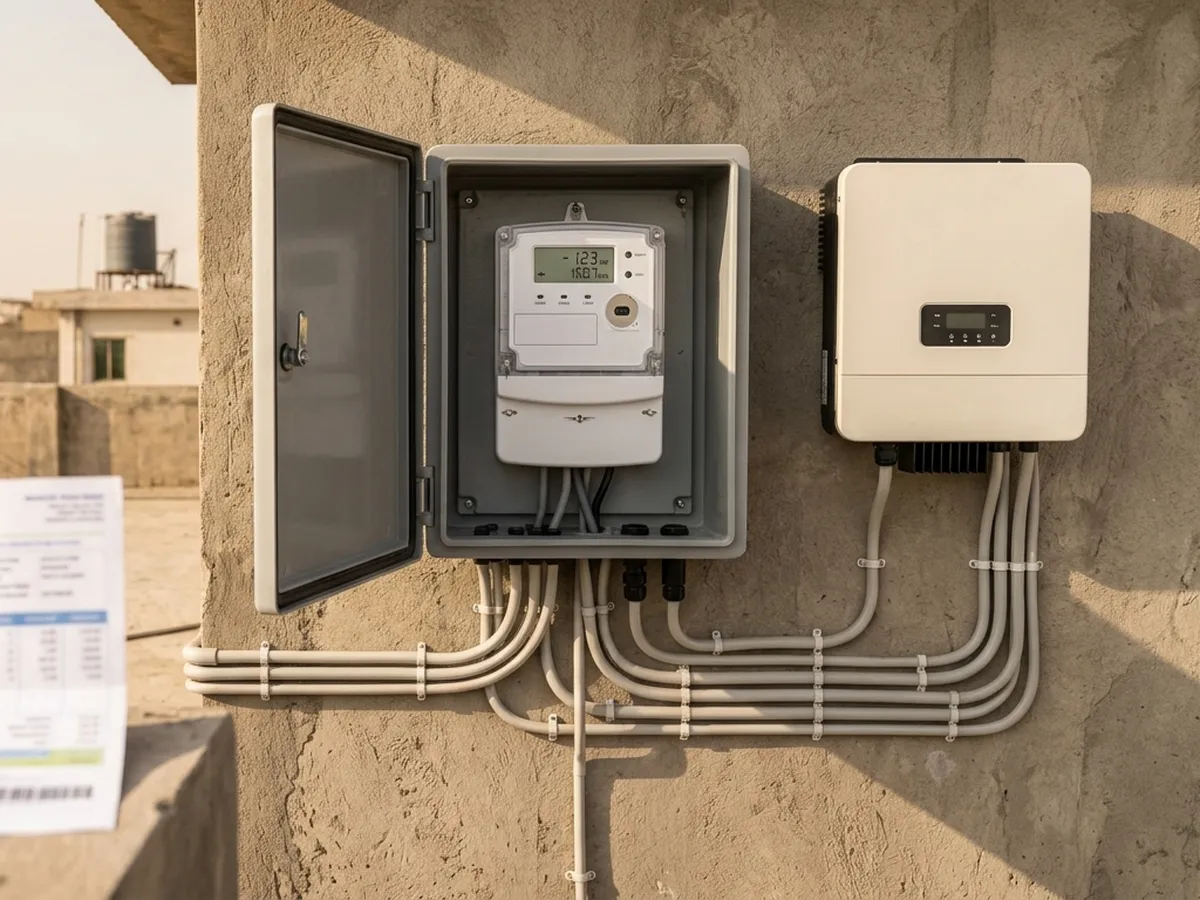
K-Electric states that applications are processed by a PPIB pre-qualified vendor on behalf of the consumer. The vendor uploads your scanned documents on the K-Electric website, and you receive a provisional case ID and login by SMS and email.
We are not a PPIB pre-qualified vendor, so we do not file K-Electric applications ourselves. We design, supply and install the system. If you want a grid connection, a pre-qualified vendor files the case. Tell us early, so the design, the inverter data sheet and the settings match what that vendor needs.
K-Electric lists the categories as residential, commercial or industrial, and mosque or trust. The page below uses the residential case first.
These are the limits K-Electric lists in its 13 April 2026 guidelines. They are targets for cases that are complete and meet the prerequisites.
| Stage | Time limit listed | What happens |
|---|---|---|
| Qualification | 5 working days | K-Electric checks that prerequisites are met |
| Technical review | 15 working days | Review under the PPIB guidelines |
| Discrepancy notice | 3 working days | The vendor is told what is missing |
| Agreement and estimate | 14 working days | Issued for qualified cases |
| Payment | 7 working days | You pay the estimate online or at partner banks |
| Meter and activation | 15 working days | Bi-directional meter installed and connection activated |
Add the main limits and you get 56 working days, a little over eleven weeks on a five-day week, if each stage used its full time. A discrepancy notice or a transformer problem adds more.
K-Electric lists these items. The vendor handles the upload, but you supply most of them.
Companies need extra papers such as Form 29, a certificate of incorporation or a partnership deed, and an NTN document. Mosques, trusts, hospitals, NGOs and schools need a deed that shows signing authority.
K-Electric names several causes in its guidelines. Most are avoidable.
K-Electric lists a generation licence fee of Rs 1,000 per kW, paid by pay order at application. K-Electric applies to NEPRA for the licence on your behalf. You also pay for meter replacement. The page lists no other fees, but your vendor may charge for its own service, so ask for that in writing.
After activation, K-Electric bills the power you import at the normal tariff. Under net billing, the power you export is bought at a lower rate, reported at roughly Rs 10 to 11 per unit. Imports and exports are billed separately.
So the aim of the design is to use the solar power yourself. Run heavy loads in daylight and consider a battery if exports earn little. The net billing guide explains the new rules in full.
K-Electric gives the email address net.metering@ke.com.pk and the KE Live number 0348-0000118 for questions on net billing. Check the K-Electric website for the current contact details before you call.
Short answers. For your own property, send us your electricity bill and roof details.
Ask on WhatsAppNo. We are not PPIB pre-qualified, so we do not file applications. We design and install the system, and a PPIB pre-qualified vendor files the case.
K-Electric lists time limits that add up to about 56 working days if each stage uses its full time. Missing papers or transformer limits add more.
A CNIC copy and a recent K-Electric bill with matching names, the vendor checklist and certificate, the inverter data sheet and settings letter, and the licence fee pay order.
K-Electric lists Rs 1,000 per kW, paid by pay order at the time of application.
Only with the owner's permission. K-Electric lists unconfirmed roof ownership as a rejection reason.
Rules and figures on this page were checked in October 2026. They change, so confirm the current position before you commit money.
What replaced net metering, the K-Electric process and ways to pay for solar.
3 kW, 5 kW and 6 kW systems: output, roof area, loads and quote checks.
The installation process, how to vet a solar company and Karachi site issues.
Government solar programmes in Sindh, who they cover and how to check them.
Tell us your sanctioned load and your roof. We will design the system and give you a free estimate, ready for the vendor you choose.