Home Solar
Planning a home solar system in Karachi: bill, roof, size, type and common mistakes.
A house, a shop and a factory use power in different ways. Your solar system should follow your own pattern of use, not a standard package.
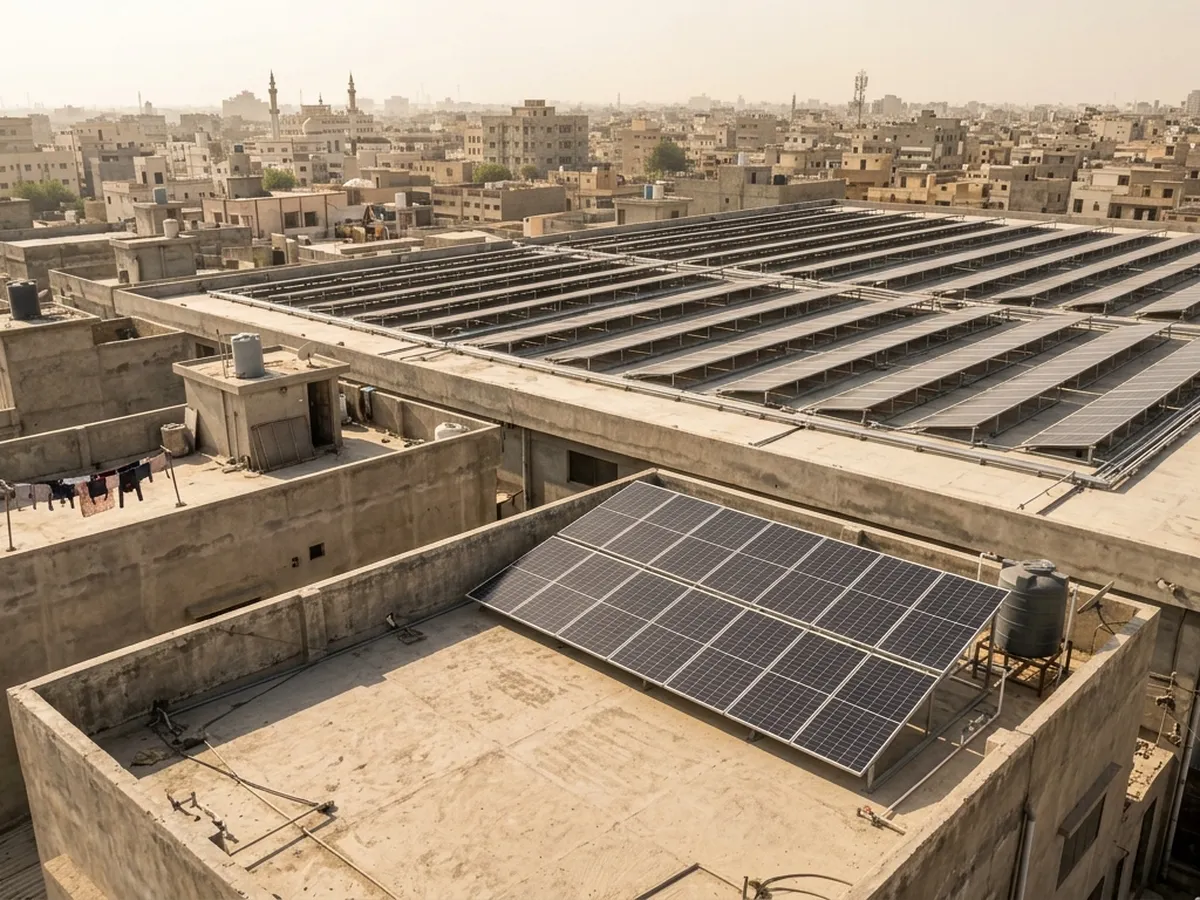
Solar panels make power only in daylight. A system works best when you use much of that power as it is produced. That is why a shop open all day and a home that is empty until evening need different designs, even at the same monthly bill.
Since the 2026 net billing rules, power you send to the grid earns far less than power you use yourself. Matching your daytime load matters more than ever. The net billing guide explains the new rules.
We begin with your last few K-Electric bills and a short conversation about when you use power. Then we shape the system around that.
These are starting points, not fixed rules. Your survey may point somewhere else.
| Property | Usual pattern of use | System that often fits |
|---|---|---|
| House | Heavy use in the afternoon and evening, air conditioners in summer | Hybrid with a battery if outages are long, on-grid if they are short |
| Apartment | Similar to a house, but roof access is shared | Small system, only if you have the right to use roof space |
| Shop or small office | Power use mostly during opening hours | On-grid system sized to daytime load |
| Clinic or school | Daytime use, with some backup need | On-grid, with a small battery for key loads |
| Factory or warehouse | High daytime load, often three-phase | Larger on-grid system with three-phase inverters |
| Mosque or trust | Regular use on set hours | On-grid system, with the trust papers K-Electric asks for |
Three points decide what a utility will approve, and you should check them before you order.
Sanctioned load. Under the K-Electric guidelines, the connected load must match the sanctioned load, and the regulations tie the solar system size to it. If they do not match, you must correct the load first.
Single or three phase. Homes are usually single phase. Many shops and all factories are three phase. The inverter must match the supply.
Meter and category. K-Electric lists residential, commercial or industrial, and mosque or trust as applicant categories. Each meter on a premises is treated on its own.
Suppose a shop uses 30 units a day, mostly while it is open. Divided by a planning figure of 4 to 5 units per kW per day, that points to about 6 to 7.5 kW of panels. A site survey then checks roof area, shading and the sanctioned load. This is an illustration, not a quote.
Bigger systems bring more checks. K-Electric requires a no-objection certificate and an approved load flow study for cases above 250 kW. The roof must carry the weight, with safe walkways, cable routes and clear isolation points for firefighters.
For a factory or warehouse, we look at the daily load curve, the transformer, and future growth. Ask us about large systems and we will tell you what additional papers your case needs.
Solar on an apartment building is a question of rights before it is a question of technology. You need permission to use roof space, a safe cable route, and a meter that can be connected. K-Electric lists unconfirmed roof ownership among rejection reasons.
If your building has a managing committee, raise the idea there first. A shared system can sometimes serve common loads such as lifts and lights. Tell us your building details and we will advise on what is realistic.
Short answers. For your own property, send us your electricity bill and roof details.
Ask on WhatsAppOften yes, because shops use power during the day when solar produces. The result depends on your bill, roof and sanctioned load. Send us your bill for an estimate.
Only if the owner agrees. K-Electric also asks for confirmation of roof ownership for grid-connected systems.
Larger cases need extra papers. K-Electric lists a no-objection certificate and a load flow study above 250 kW.
If your supply is three phase, usually yes. We check your meter during the survey.
Only with a hybrid inverter and enough battery for the loads you choose. We size it with you.
Planning a home solar system in Karachi: bill, roof, size, type and common mistakes.
Commercial solar in Karachi: daytime load, three-phase supply, approvals and contracts.
System sizes, what a full quote includes and how to size from your bill.
What replaced net metering, the K-Electric process and ways to pay for solar.
The installation process, how to vet a solar company and Karachi site issues.
Lithium vs tubular batteries, sizing for load-shedding and cost per kWh.
Send your K-Electric bill, your building type and your area in Karachi. We will recommend a system and give you a free estimate.