Charge Controllers
MPPT and PWM charge controllers, with the sums to size the right amp rating.
Panels and inverters get the attention, but the small parts decide whether a system is safe and lasts. Here is what each component does and what to ask for.
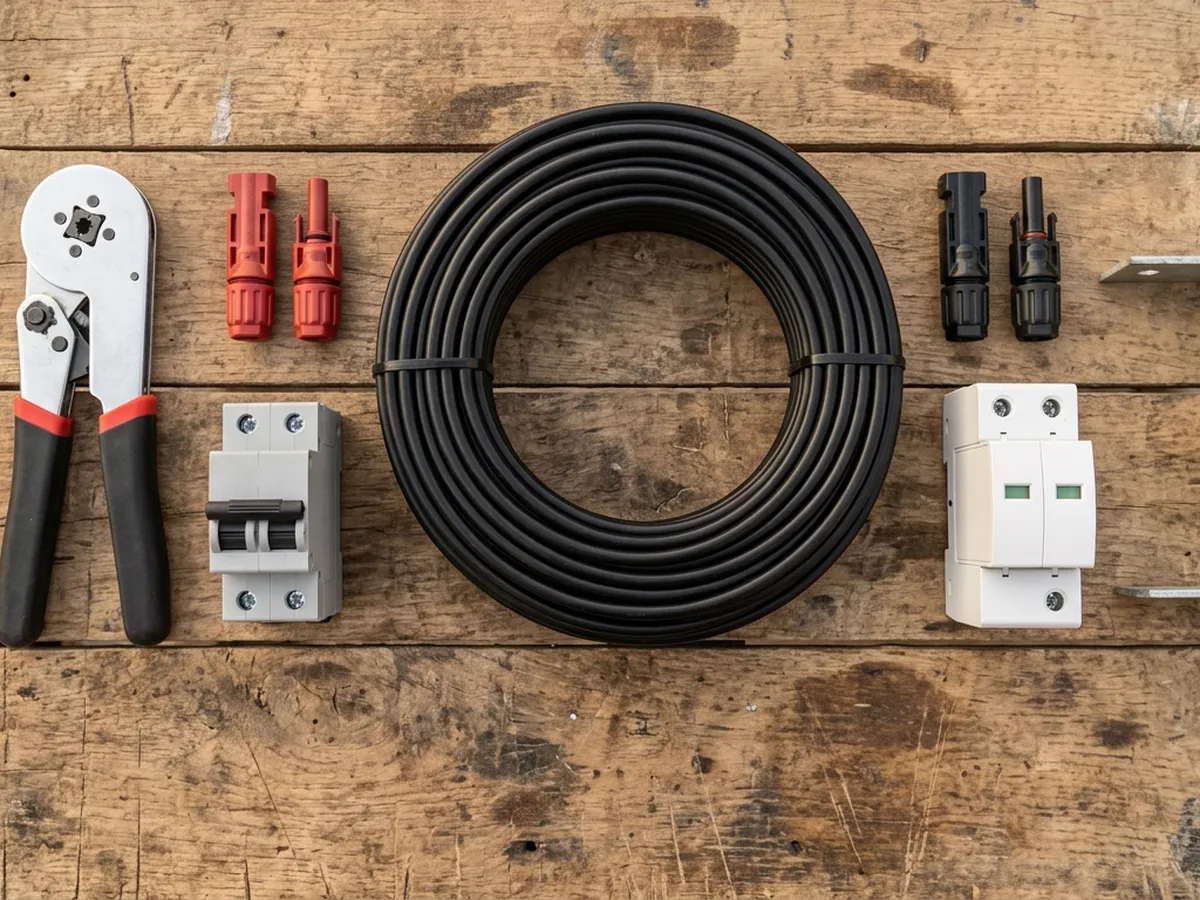
Every complete system includes these components. A good quote names each one.
| Component | What it does | What to ask the seller |
|---|---|---|
| Mounting structure | Holds panels at the right tilt and resists wind | Material, coating and how it is anchored |
| DC solar cable | Carries power from panels to the inverter | UV-resistant, double-insulated, correct size for the run |
| MC4 connectors | Join panel cables safely | Matched pairs from the same maker, properly crimped |
| DC breaker or isolator | Lets you switch off the panel side safely | Voltage and current rating for your array |
| AC breaker | Protects the inverter output line | Rating matched to the inverter |
| Surge protector (SPD) | Limits damage from voltage spikes | DC and AC side protection and type |
| Earthing | Sends fault current safely to ground | Earth pit or rod, test reading, cable size |
| Charge controller | Charges batteries in small off-grid setups | MPPT or PWM, and amp rating |
Prices change with copper and steel costs. These are the items customers ask about most.
| Item | Detail | Price (PKR) |
|---|---|---|
| MPPT charge controller | 40 A and 60 A models | Contact us for latest prices |
| Solar DC cable | Per metre, 4 mm² and 6 mm² | Contact us for latest prices |
| Mounting structure | Per panel, galvanised or aluminium | Rs 6,000 floor-mounted |
| DC breaker | Rated for your array voltage | Contact us for latest prices |
Prices updated on 22 October 2026. Prices change often, so contact us for the latest exact price.
The structure takes the weight of the panels and the force of the wind. It also sees salt air every day. Mild steel without a proper coating can rust through in a short time on the coast.
Ask whether the structure is hot-dip galvanised steel or aluminium. Check that bolts and clamps are stainless or coated. Ask how the legs are fixed to the roof: bolts into the slab or beam hold better than loose weights.
Tilt matters too. A fixed tilt close to the latitude of Karachi suits year-round output, and your installer can refine it for your roof.
Solar cable lives outdoors in sun, heat and rain. It should be rated for ultraviolet light and carry double insulation. Size depends on current and cable length. Many residential systems use 4 mm² or 6 mm² DC cable, and the installer should confirm the size for your layout.
A bad connector is a common source of heat and faults. Use matched MC4 connectors and proper crimp tools. A loose or mismatched pair can overheat.
Surge protection is cheap compared with an inverter. Storms in the monsoon season and voltage spikes on the grid can both damage electronics. Ask for protection on both the DC and the AC sides.
Several parts have published international standards, and a genuine seller can tell you which ones a product was tested to. These standards describe how the maker tests the product. They do not mean the seller holds any certification.
A charge controller sits between panels and batteries in a small off-grid system. MPPT controllers pull more energy from the panels and cost more. PWM controllers are simpler and cheaper but waste some output. Hybrid inverters already include a controller, so you only need a separate one for small standalone setups.
Short answers. For your own property, send us your electricity bill and roof details.
Ask on WhatsAppWe recommend it. A surge protector costs little compared with an inverter, and storms and grid spikes can damage electronics.
It depends on current and the length of the run. Many homes use 4 mm² or 6 mm² DC cable. Your installer should calculate it for your layout.
Both work if they are well made and well coated. Aluminium is light and resists rust. Hot-dip galvanised steel is strong and widely used. Check bolts too.
Yes. Tell us what you need and we will quote it.
Usually not. Most hybrid inverters have one built in.
MPPT and PWM charge controllers, with the sums to size the right amp rating.
DC breakers and surge protectors: ratings, standards and the mistakes to avoid.
Solar structure choices for Karachi: material, tilt, height and anchoring.
DC solar cable and MC4 connectors: size, standard, voltage drop and what to check.
System sizes, what a full quote includes and how to size from your bill.
The installation process, how to vet a solar company and Karachi site issues.
Panel brands, wattage, price per watt and what suits Karachi conditions.
Inverter types, sizing, brands and what to check before you buy.
Send us your parts list or the system you are building. We will quote every item and give you a free estimate.