Accessories
Mounting structure, cable, connectors, breakers and charge controllers explained.
Cables are cheap compared with panels and inverters, yet they cause many of the faults. The right size, standard and crimp decide how long a system stays safe.
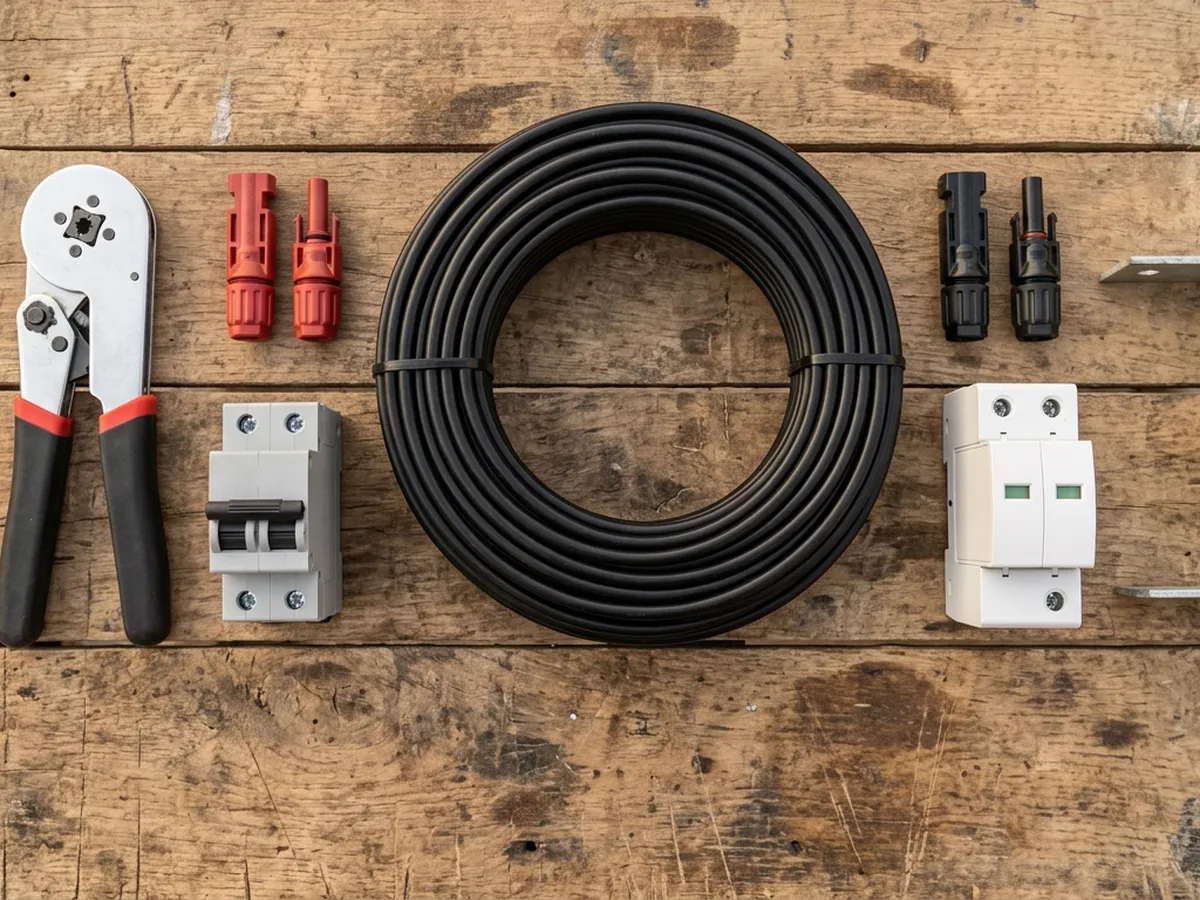
The DC side of a solar system carries current from the panels to the inverter all day, in direct sun, on a hot roof. The cable has to survive heat, ultraviolet light, rain and years of expansion and contraction.
A cable made for a house wall will not do that job. A proper solar cable has insulation rated for sunlight and temperature. A wrong one cracks, and a cracked DC cable is a fire risk.
Cable is priced per metre. Connectors are priced per pair.
| Item | Detail | Price (PKR) |
|---|---|---|
| Solar DC cable, 4 mm² | Per metre, red or black | Rs 270 |
| Solar DC cable, 6 mm² | Per metre, red or black | Rs 350 |
| MC4 connector pair | Male and female | Rs 250 |
| Battery cable | Per metre, sized to the current | Rs 750 |
Prices updated on 22 October 2026. Prices change often, so contact us for the latest exact price.
Ask for the standard on the cable, and look for it printed on the sheath.
Every cable resists current, and that resistance wastes a little power as heat. The longer the run and the thinner the cable, the more is lost. The sum is: drop in volts equals 2 times current times one-way length times resistivity, divided by the cross-section area.
For copper, use a resistivity of about 0.0175 ohm square millimetres per metre at room temperature. Hot cable on a roof resists more, so allow a margin.
Take an invented example with a string current of about 14 A and a one-way run of 30 m. On 4 mm² cable the drop is 2 times 14 times 30 times 0.0175, divided by 4, which is about 3.7 V. On 6 mm² it is about 2.5 V. On a string of several hundred volts, both are small. A common design aim is to keep the drop to a few percent at most.
General guidance. The right size depends on current, length and the installation method.
| Part of the system | Typical choice | Notes |
|---|---|---|
| Panel to panel in a string | 4 mm² DC cable | Short runs, standard MC4 leads |
| String to inverter | 4 mm² or 6 mm² DC cable | Move to 6 mm² on long runs |
| Battery to inverter | Heavy battery cable | Sized to the full current, kept short |
| Inverter to the board | AC cable sized to the inverter rating | Follows the breaker size |
| Earth | Earth conductor to the correct size | Kept short and firmly bonded |
MC4 connectors are simple, but they fail when badly fitted. The most common faults are a poor crimp, mixed connector brands that fit loosely, and unlatched joints that arc.
Use the right crimping tool, and use matching connectors on both ends. Pull-test each joint. Never leave DC connectors lying in water or on the ground.
Connectors from different makers can look identical and still fit loosely. A loose joint heats up and can arc. Ask the installer to use matched pairs and to keep the spare connectors in the box, labelled.
Short answers. For your own property, send us your electricity bill and roof details.
Ask on WhatsAppIt depends on the size, the maker and the length. Send us the length you need and we will quote per metre.
4 mm² is common for strings. 6 mm² is used on long runs or higher currents. The voltage drop sum decides.
It is a European standard for solar DC cable. Look for it printed on the sheath.
No, not on the DC side. It lacks the ultraviolet and temperature rating that solar cable has.
Mostly from poor crimps, mismatched connectors and joints that were not pushed home.
Mounting structure, cable, connectors, breakers and charge controllers explained.
DC breakers and surge protectors: ratings, standards and the mistakes to avoid.
MPPT and PWM charge controllers, with the sums to size the right amp rating.
What sets solar installation cost, what a quote should include and approval costs.
Send the string layout and the run lengths. We will size the cable and give you a free estimate.