K-Electric Net Metering
A checklist of K-Electric documents, time limits and common rejection reasons.
Pakistan changed its solar export rules in 2026. This page explains what replaced net metering, how a K-Electric application works, and what it means for your system.
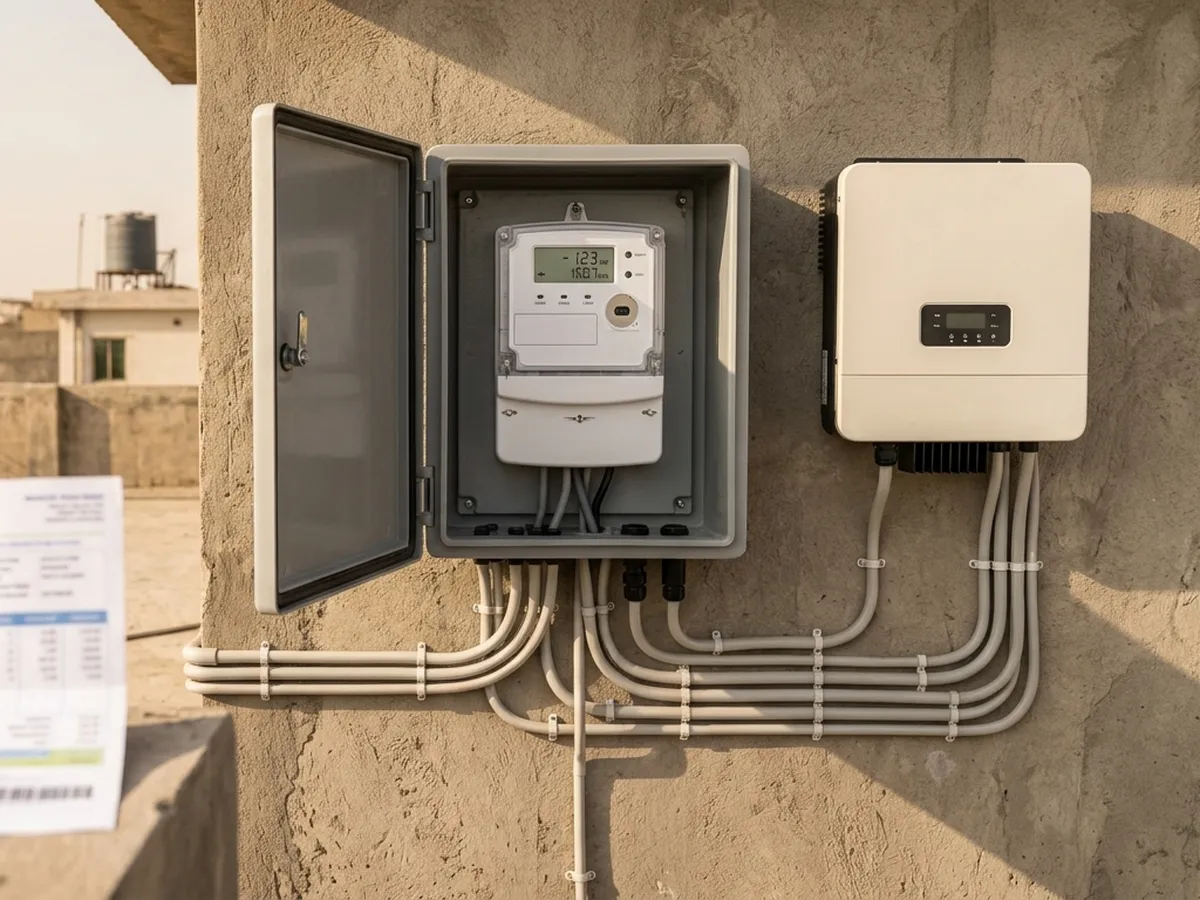
Under net metering, a solar home sent extra power to the grid and got units credited at a high rate, reported at about Rs 26 per unit. In February 2026 Pakistan's power regulator, NEPRA, notified new prosumer regulations that replace this with net billing.
Under net billing, the utility buys your exported power at a lower rate, reported at roughly Rs 10 to 11 per unit. You pay for the power you import at the normal tariff. The two are billed separately.
Applications filed up to 8 February 2026 were to be handled under the previous framework, after a Power Division directive on 19 February. Reports differ on how existing net metering customers are treated, so check your own agreement with K-Electric.
This table summarises the main differences as reported in early 2026. Final details can change, so confirm with K-Electric.
| Point | Net metering (older) | Net billing (new applications) |
|---|---|---|
| Price paid for exports | About Rs 26 per unit, as reported | About Rs 10 to 11 per unit, as reported |
| Billing | Exports offset imports | Imports and exports billed separately |
| System size limit | Up to 1.5 times sanctioned load | Tied to sanctioned load |
| New contract term | Seven years | Five years |
| Licence fee | Earlier rules differed by system size | Rs 1,000 per kW at application |
The figures come from news reports of the NEPRA regulations and from K-Electric's own guidelines. See the sources below.
K-Electric published net billing guidelines on 13 April 2026. These are the steps and the time limits it lists.
The application goes through a PPIB pre-qualified vendor, who uploads your documents on the K-Electric net metering page. You get a case ID and login by SMS and email.
K-Electric lists a time limit of 5 working days for qualification, if all prerequisites are met.
The technical review is listed at 15 working days. A discrepancy notice, if needed, follows within 3 working days.
For qualified cases K-Electric lists 14 working days to issue the agreement and the estimate.
You pay the estimate within 7 working days. K-Electric lists 15 working days after payment to install the bi-directional meter and activate the connection.
K-Electric lists these items for a residential application. Companies and trusts have extra papers.
The generation licence fee is Rs 1,000 per kW, paid by pay order at application. K-Electric applies to NEPRA on your behalf. You also bear the cost of meter replacement. A connected load that does not match the sanctioned load must be regularised before you apply.
Exports now earn far less than the power you save by using your own solar. If you export 10 units on a day and the grid price you avoid is Rs 37 to 55 per unit, using those units at home is worth several times more than selling them at about Rs 11. The Dawn report gave import rates in that range, before taxes.
So design for self-consumption. Run heavy loads in daylight, consider a battery to shift solar power into the evening, and keep the array within your sanctioned load. We build the estimate around your own usage pattern.
There are three common ways to pay: cash, bank financing and seller instalments. Banks in Pakistan have offered solar financing, and JS Bank, for example, has a product called Smart Roshni Solar Financing. Terms, markup and eligibility change, so check the current offer with the bank.
If a seller offers instalments, ask for the total amount you will pay, the monthly amount, and the cash price. The gap between the cash price and the total instalment price is the real cost of the plan. Also ask what happens if you want to settle early.
If you plan to finance, tell us early. We will give you a clear written quotation that you can take to the bank.
Short answers. For your own property, send us your electricity bill and roof details.
Ask on WhatsAppFor new applications, net billing replaced it from February 2026. Applications filed up to 8 February 2026 were to be processed under the previous framework. Check your case with K-Electric.
News reports put the new export rate at roughly Rs 10 to 11 per unit. The rate can change, so confirm the current figure with K-Electric or NEPRA.
K-Electric's guidelines list time limits for each stage, which add up to several weeks when everything is in order. Missing documents or transformer limits can make it longer.
K-Electric lists Rs 1,000 per kW, paid by pay order. NEPRA also reported this fee as part of its April 2026 changes.
Yes, for most homes, when it is sized for own use. Savings come mainly from the power you use directly. A system sized to export a lot is the weaker choice now.
No. We are not PPIB pre-qualified, so we do not file K-Electric applications. We design, supply and install the system. The application must go through a PPIB pre-qualified vendor. Tell us early so the design fits their requirements.
Rules and figures on this page were checked in October 2026. They change, so confirm the current position before you commit money.
A checklist of K-Electric documents, time limits and common rejection reasons.
Government solar programmes in Sindh, who they cover and how to check them.
Sales tax on imported solar panels: the rate, the budget history and your invoice.
Bank solar loans in Karachi: what is offered, what changed and how to prepare.
How installment plans for solar work, what to ask and what to avoid.
System sizes, what a full quote includes and how to size from your bill.
Inverter types, sizing, brands and what to check before you buy.
The installation process, how to vet a solar company and Karachi site issues.
How solar works, what Karachi's climate means, and how to plan a project.
Send your K-Electric bill and your sanctioned load. We will size a system for your own use and give you a free estimate.