Home & Commercial
Which system fits a home, apartment, shop, office or factory.
A home solar project goes best when you bring the right information. This page lists what to gather, what to expect and the mistakes to avoid.
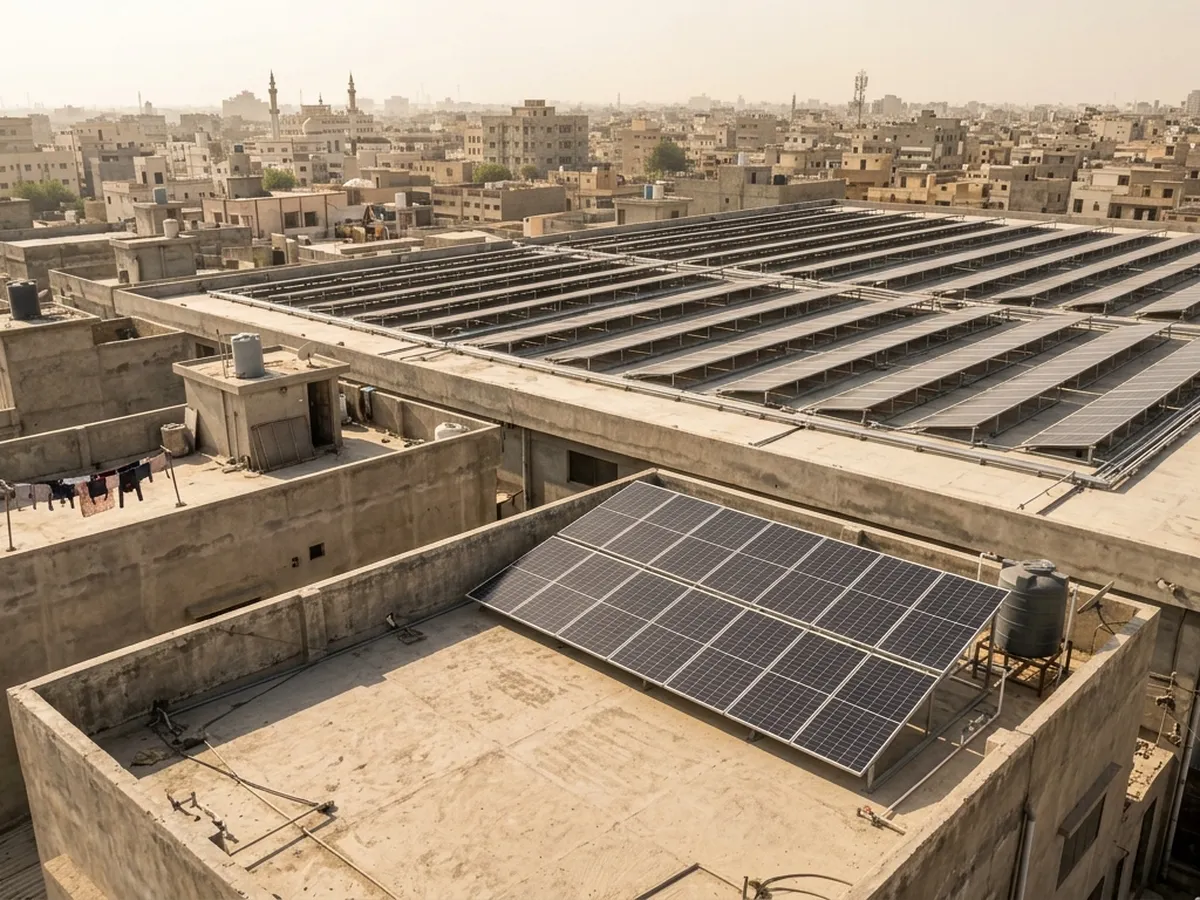
You already hold most of the information a solar planner needs. It sits on your electricity bill, in your appliance list and on your roof.
Bring four things: your last few K-Electric bills, with the units and the sanctioned load, a list of the appliances you want to run in a cut, a photo of your roof and a note of your area. With those we can suggest a size and a type in one conversation.
The sections below show how those four items turn into a system.
Starting points only. A site visit confirms the real answer.
| Home | Typical use | System to discuss |
|---|---|---|
| Small flat or portion, fans and lights | Low, with a fridge and TV | 1 to 2 kW, often hybrid with a small battery |
| Single-storey house, one inverter AC | Medium, mostly day and evening | 3 to 5 kW, on-grid or hybrid |
| Two-storey house, two ACs, a pump | High, with summer peaks | 5 to 8 kW, often hybrid |
| Large house or bungalow, many ACs | Very high | 8 kW and above, three-phase if the supply is |
| Rented house | Depends on the owner | Only with the owner's written permission |
This is the order we follow.
Look at your summer and winter bills. Summer is usually the peak.
Lower the bill, get backup in cuts, or both. The goal sets the type.
K-Electric ties a grid-connected system to the sanctioned load, and the connected load must match.
Flat area, shade from tanks and stair rooms, and access to carry panels.
On-grid, hybrid or off-grid, then panels, inverter and battery.
These repeat across homes.
If you rent, or your roof is shared with other flats, you need permission first. K-Electric lists unconfirmed roof ownership among reasons it can reject an application. Settle this before you spend anything.
Read our 3 to 6 kW system guide for output figures and the system types page to choose between on-grid and hybrid. If you plan to run an air conditioner, the solar AC guide shows the sums. Then send us your bill and we will reply with an itemised estimate.
Short answers. For your own property, send us your electricity bill and roof details.
Ask on WhatsAppIt depends on the size, the type and the brands. Send your bill and your area and we will give you a free itemised estimate.
Divide your monthly units by 30, then by about 4 to 5 units per kW per day. A site visit confirms it.
Only if you want power in cuts. Without one, a grid-tied system stops when the grid stops.
Only with the owner's agreement. Grid-connected systems also need proof of roof ownership.
Send a photo of your latest K-Electric bill, your area and your appliance list on WhatsApp.
Which system fits a home, apartment, shop, office or factory.
3 kW, 5 kW and 6 kW systems: output, roof area, loads and quote checks.
Complete hybrid, on-grid and off-grid systems: parts, cost drivers and who each suits.
Running a 1 ton or 1.5 ton AC on solar: panels, batteries and the type of AC to choose.
Send your latest bill, a photo of your roof and your area. We will give you a free itemised estimate.