Solar Appliances
Solar AC, geyser, lights, pumps and fans: how to power each one.
The air conditioner is the biggest summer load in Karachi, so it decides the size of your solar system. Here is how to power one, by day and by night.
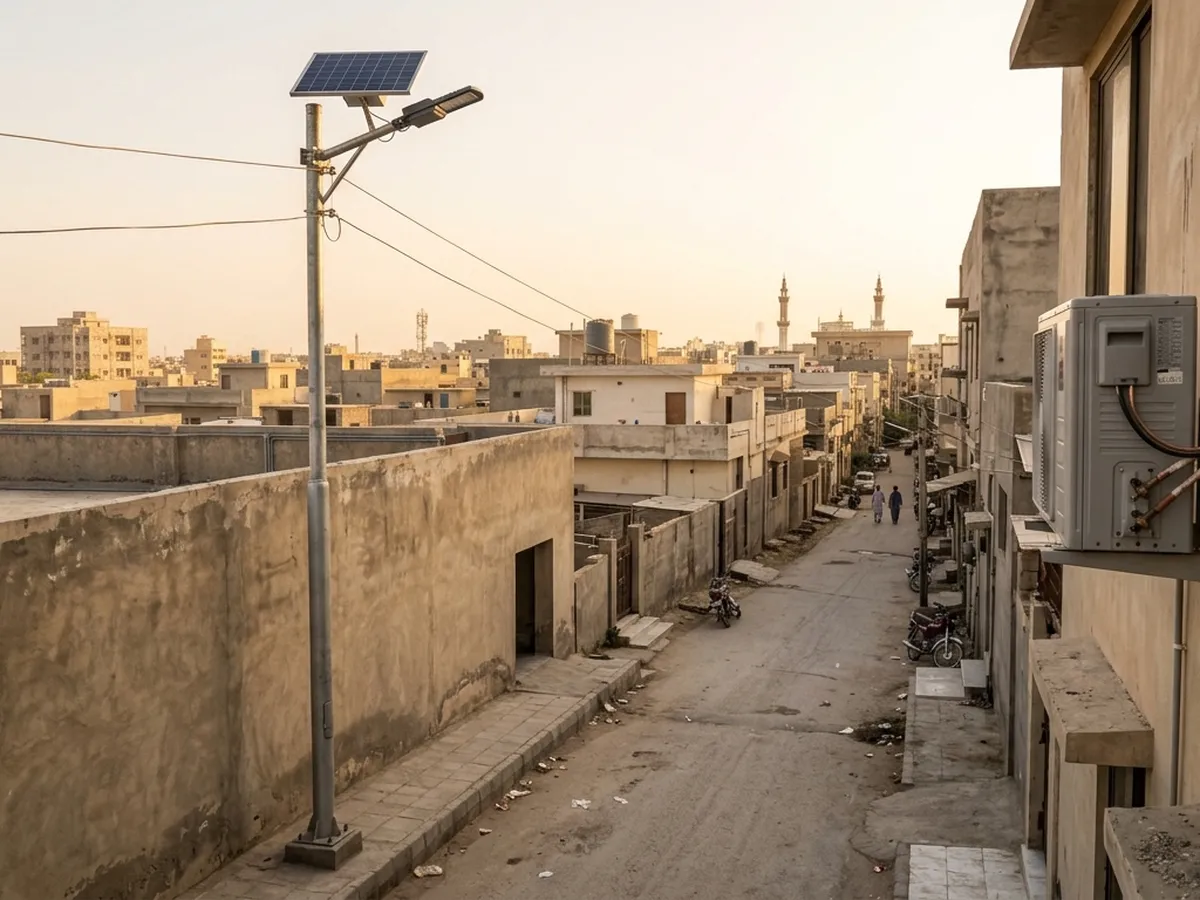
When people search for a solar AC, they mean one of two things. The first is an ordinary air conditioner that runs from a home solar system through the inverter. The second is a unit sold as a solar or hybrid AC, which can take power straight from panels and switches to the grid when the sun is low.
Both work. The first is the more common route, because it uses a normal AC that any repair shop knows, and the same system also runs your other loads. The second can be efficient for a single room, but it ties the AC to its own panels and wiring.
Before you ask for a price, decide which one you mean. The rest of this page covers both.
Prices are for the air conditioner only. Panels, inverter and battery are separate.
| Item | Detail | Price (PKR) |
|---|---|---|
| Solar AC, 1 ton | DC or hybrid type | Contact us for latest prices |
| Solar AC, 1.5 ton | DC or hybrid type | Contact us for latest prices |
Prices change with the exchange rate and stock. Contact us for the latest prices.
A worked example with approximate numbers. Read the label on your own AC, since models vary.
A 1.5 ton inverter AC, which is 18,000 BTU per hour of cooling, might draw about 1.2 kW while running. A fixed-speed AC of the same size can draw more.
Eight hours of daytime use at 1.2 kW is about 9.6 kWh, or 9.6 units.
At a planning figure of 4 to 5 units per kW per day, 9.6 units needs about 2 to 2.4 kW of panels, which is four 585 W panels.
Fans, lights, fridge and TV add to the load. This is why a 5 kW system is common for a house with one or two ACs.
The sun sets, but the heat does not. Here is what each choice means for the system.
| Choice | What you need | Notes |
|---|---|---|
| AC by day only | Panels and an inverter sized for the AC, no battery | Lowest cost. Switch to the grid at night. |
| AC by day and evening | A moderate battery for the evening hours | Charges from spare solar by day. |
| AC all night | A large battery bank | A 1.2 kW AC for 8 hours uses about 9.6 kWh, which is two 5 kWh lithium batteries. |
| AC on grid, solar cuts the bill | On-grid system, no battery | Savings come mainly from daytime use. |
The type of AC changes the system size more than almost any other choice.
An air conditioner draws a burst of current when the compressor starts. The inverter must handle that burst. Check the surge rating on the inverter datasheet and the starting current on the AC label. Our inverter size guide shows how to size for it.
The AC runs hardest when the sun is strongest, so an AC is the best use of your own solar power. Under net billing, exported power earns far less than power you use yourself, so running the AC from your own panels is the best use of the system. See the net billing guide for the rules.
Short answers. For your own property, send us your electricity bill and roof details.
Ask on WhatsAppYes. Size the panels and the inverter for the AC running power and its start-up surge. Daytime use suits solar well.
A 1.5 ton inverter AC used for 8 hours by day may need about four 585 W panels, depending on its running power and the sunshine. Read your AC label.
Only with a large battery or the grid. A 1.2 kW AC for 8 hours uses about 9.6 kWh.
Yes, because it draws less power and starts more gently. A fixed-speed AC needs a larger inverter.
It depends on the type, the brand and the tonnage. Send us what you have in mind and we will quote it.
Solar AC, geyser, lights, pumps and fans: how to power each one.
3 kW, 5 kW and 6 kW systems: output, roof area, loads and quote checks.
Inverter sizes from 1 kW to 10 kW and what each can run.
Lithium LiFePO4 batteries: capacity maths, compatibility and safe placement.
Send your bill and the AC model you have or plan. We will size the system and give you a free estimate.