Solar Guide
How solar works, what Karachi's climate means, and how to plan a project.
Tilt and direction decide how much sun a panel catches. In Karachi the answer is simple: face south and tilt near the latitude.
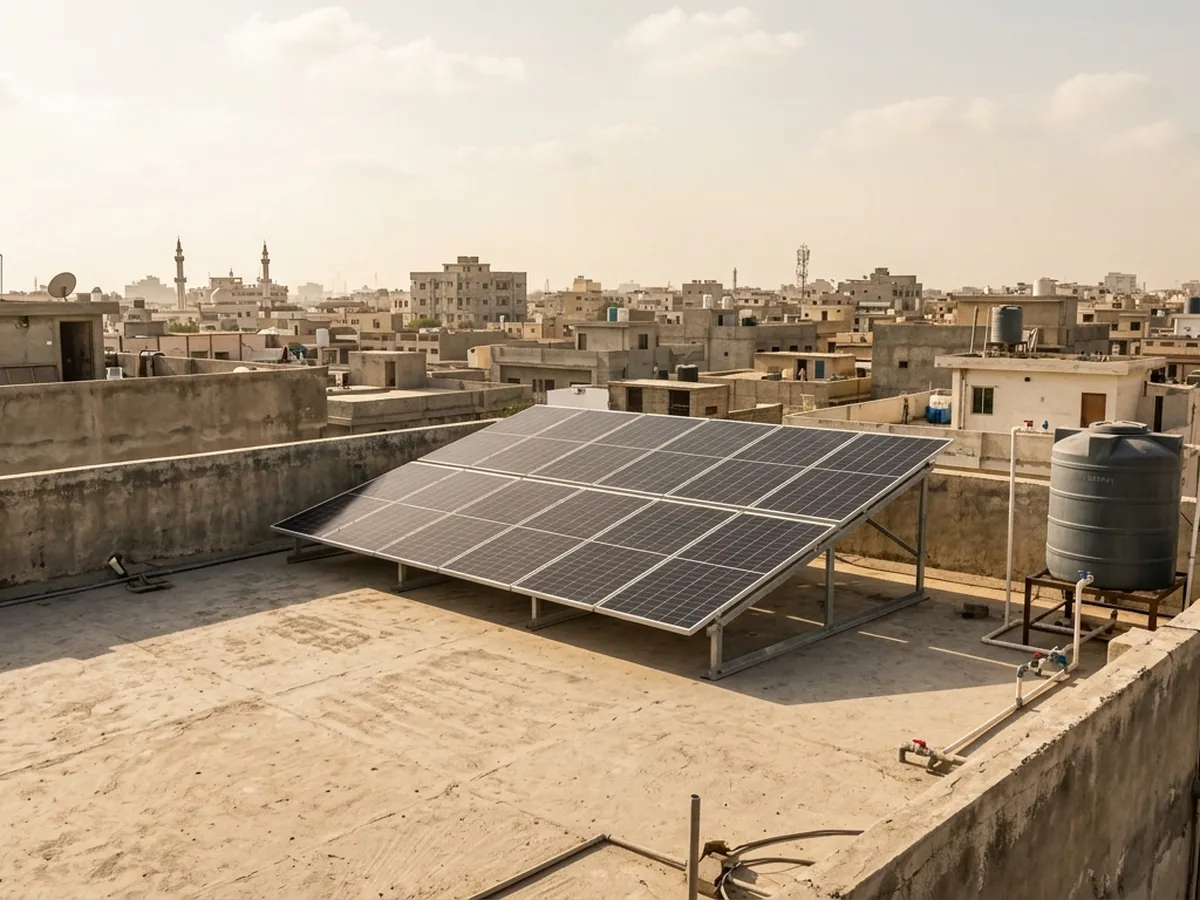
Karachi lies in the northern hemisphere, so the sun sits in the southern half of the sky at midday. Panels should face south. A panel that faces east or west still works, but loses some output.
Face true south, not magnetic south. A compass can read off true south, so check with a phone map or the roof's alignment. A deviation of ten or fifteen degrees costs very little.
Karachi's latitude is about 24.86°N. Noon elevation equals 90° minus latitude plus or minus the sun's declination.
| Date | Sun declination | Noon sun elevation | Tilt that faces the sun squarely |
|---|---|---|---|
| Winter solstice, 21 December | about -23.44° | about 41.7° | about 48.3° |
| Equinoxes, March and September | about 0° | about 65.1° | about 24.9° |
| Summer solstice, 21 June | about +23.44° | about 88.6° | about 1.4° |
The squarely facing tilt equals 90° minus the noon elevation. Figures are rounded.
A panel gets the most sun when it faces the sun at right angles. In winter that needs a steep tilt of about 48 degrees. In summer the sun is almost overhead, so a nearly flat panel is best.
A fixed panel has to compromise. A common rule of thumb for the whole year is a tilt close to the latitude, so about 25 degrees in Karachi. Another is to favour the season of highest use. We cover the trade-offs below.
A guide. The gains and losses between these options are small.
| Choice | Tilt | Best for | Cost |
|---|---|---|---|
| Near latitude | about 25° | Steady output across the year | Standard frames |
| Lower tilt | 10° to 15° | Summer output, shorter row spacing, less wind load | Slightly lower winter output |
| Steeper tilt | 30° to 40° | Winter output | Longer shadows, wider row spacing |
| Adjustable by season | 10° summer, 40° winter | A little extra output | Needs climbing to change it twice a year |
The gain from adjusting tilt twice a year is usually small, and the cost is climbing up with tools. Wind, weight and cleaning matter more. A fixed tilt around 15 to 25 degrees is a reasonable compromise, because it keeps rows closer, reduces wind load and lets rain and cleaning shed dust.
On a sloped roof, the panels usually follow the roof angle. If the roof faces south and is near 25 degrees, that is close to ideal. If it faces east or west, panels still work but you may lose some output, and you may add panels to make up for it.
On a flat roof you choose the tilt. A lower tilt packs more panels on the roof but gives less in winter. A higher tilt needs wider spacing between rows. Our panel size calculator has a worked row-spacing example for 25 degrees.
A panel tilted very flat collects dust and water. Aim for at least about 10 degrees so that rain and rinse water run off. Check the structure for wind: a steeper tilt acts more like a sail, and the frame, bolts and anchors must be sized for it. See our panel stand guide.
Shade matters more than a few degrees of angle. A panel partly in shade can lose far more than one at the wrong tilt.
Short answers. For your own property, send us your electricity bill and roof details.
Ask on WhatsAppAbout 25 degrees is a good fixed tilt for the year, close to the latitude of 24.86°N. Lower tilts suit summer, steeper ones winter.
South, since Karachi is in the northern hemisphere.
At noon on 21 December it is about 41.7 degrees above the horizon.
The gain is small, and a fixed tilt is simpler and safer to maintain.
You can, but dust and water stay on the glass and winter output falls. A tilt of at least about 10 degrees is better.
How solar works, what Karachi's climate means, and how to plan a project.
Sunshine hours, peak sun hours and what heat and humidity do to solar output in Karachi.
Panel dimensions, roof area per kW and row spacing worked out for Karachi.
Solar structure choices for Karachi: material, tilt, height and anchoring.
Send a photo of the roof and your area. We will tell you the direction and a suitable tilt. The estimate is free.