Solar Guide
How solar works, what Karachi's climate means, and how to plan a project.
Karachi is sunny for most of the year. This page explains what that means in numbers and how heat, haze and humidity reduce what a panel delivers.
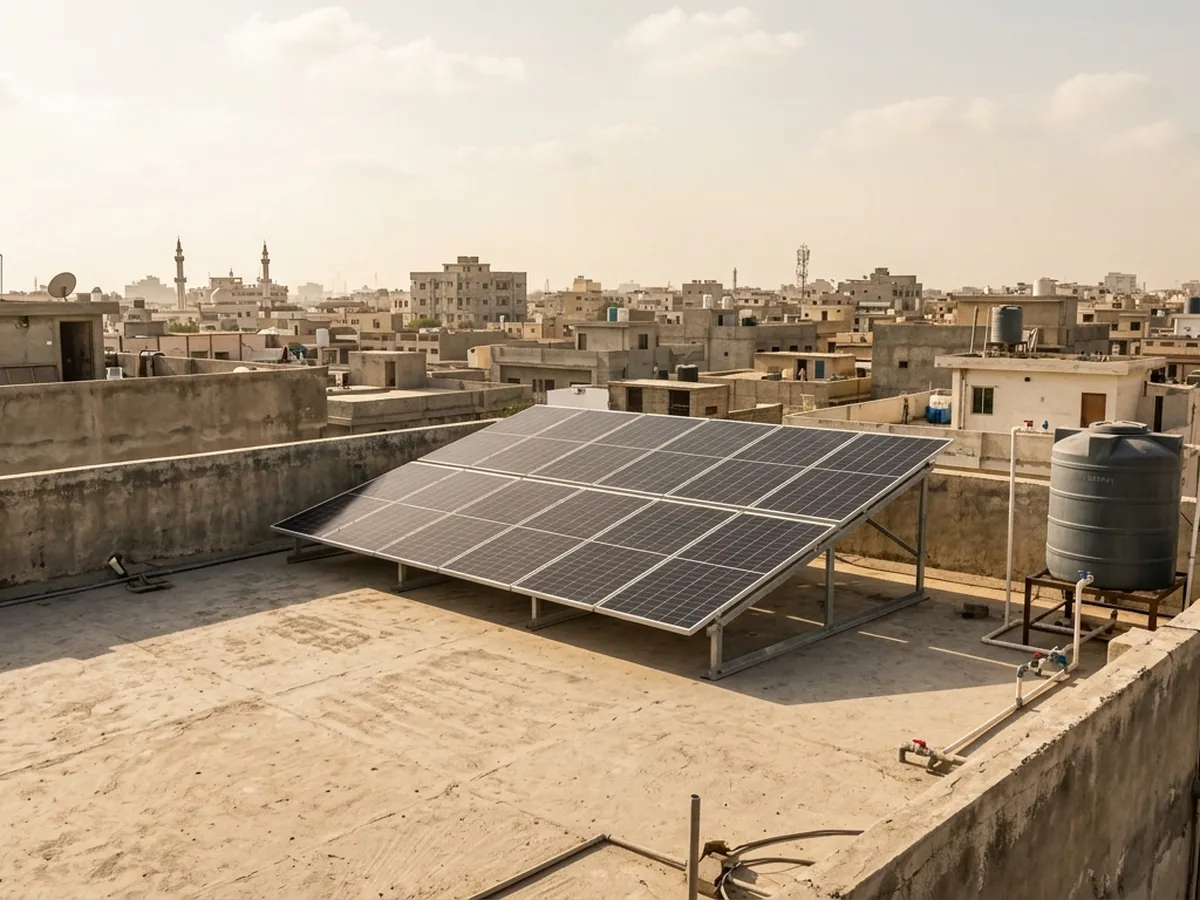
According to the climate data on Wikipedia, Karachi receives about 2,949 hours of sunshine a year, which is about 8.1 hours a day on average. The daily maximum temperature averages about 35.7°C in May and June. Relative humidity averages about 61 percent over the year, and is about 75 percent in August. Rainfall is about 318 mm a year.
Those are weather figures, not solar figures. Sunshine hours count the time the sun is bright enough to cast a shadow. They do not measure the energy that falls on a panel. For that you need irradiation.
Long-term averages from Wikipedia's Karachi climate table.
| Measure | Figure | What it means for solar |
|---|---|---|
| Sunshine | About 2,949 hours a year, 8.1 a day | Plenty of sun for most of the year |
| Hottest months | Daily maximum about 35.7°C in May and June | Panels run hotter and lose some efficiency |
| Humidity | About 61 percent a year, about 75 percent in August | Haze and cloud in the monsoon cut output |
| Rainfall | About 318 mm a year | Rain washes dust off but brings cloud |
Solar planners convert daily irradiation into peak sun hours. One peak sun hour means 1 kWh of sunlight per square metre. A site with 5 peak sun hours has received as much energy as 5 hours of full, perfect sun.
Wikipedia's page on solar power in Pakistan gives a figure of 5.3 kWh per square metre per day for the country as a whole. That is a national figure, not a Karachi measurement, so we use it only as a rough guide. We do not quote a site-specific irradiation number for Karachi, because we have not found a source we can cite. Ask any seller who does to name theirs.
Why we plan on 4 to 5 units per kW per day.
A planning figure near 5 peak sun hours a day.
Heat, dust, cable loss, inverter loss and mismatch together often cost 15 to 25 percent.
5 hours times 0.8 is 4 units for every kW of panels. On a very clear day it is higher.
We plan on 4 to 5 units per kW per day, then check it against the season.
A panel makes less power when it is hot. Datasheets give a temperature coefficient, often around 0.3 to 0.4 percent of power lost for each degree above 25°C of cell temperature. A cell on a roof in summer can run 20 to 30 degrees above the air temperature.
As an illustration, air at 35.7°C and a cell 25 degrees hotter gives a cell near 60°C. That is 35 degrees above 25°C. At 0.35 percent per degree the loss is about 12 percent. This is a rough sum, not a measurement, but it explains why a panel rated 585 W does not make 585 W on a Karachi afternoon.
Dust on the glass can cut output by a noticeable amount. Haze and monsoon cloud in July and August lower it further. A routine rinse in the early morning helps with dust. Nothing helps with cloud, so expect the clear months to carry the year. Our maintenance guide has a cleaning schedule.
A system sized on the best day will disappoint on the average one. Sizing on 4 to 5 units per kW per day, and checking the result against your bill, avoids that. You can run the sums yourself with our solar calculator guide.
Where your roof faces, how it is tilted and what shades it matter as much as the climate. See our panel angle guide.
Short answers. For your own property, send us your electricity bill and roof details.
Ask on WhatsAppAbout 2,949 hours of sunshine a year, or about 8.1 hours a day on average, according to Wikipedia's climate data.
Peak sun hours measure daily sunlight as hours of full sun. One peak sun hour is 1 kWh of sunlight per square metre.
We plan on 4 to 5 units per day, after losses. The real figure depends on season, shade, tilt and dust.
Yes. Panels lose a small share of power for each degree above 25°C of cell temperature.
No, but cloud and haze cut output in July and August.
Rules and figures on this page were checked in October 2026. They change, so confirm the current position before you commit money.
How solar works, what Karachi's climate means, and how to plan a project.
Best tilt and direction for solar panels in Karachi, with the sun angle by season.
A six-step solar sizing method with a worked example and worksheet.
Size a whole solar system on paper: panels, inverter, battery, cost and payback.
Send your bill and a roof photo. We will estimate the units and size the system. The estimate is free.