Solar Guide
How solar works, what Karachi's climate means, and how to plan a project.
You do not need a website tool to size a solar system. Six steps and a calculator are enough, and the method shows you what each number means.
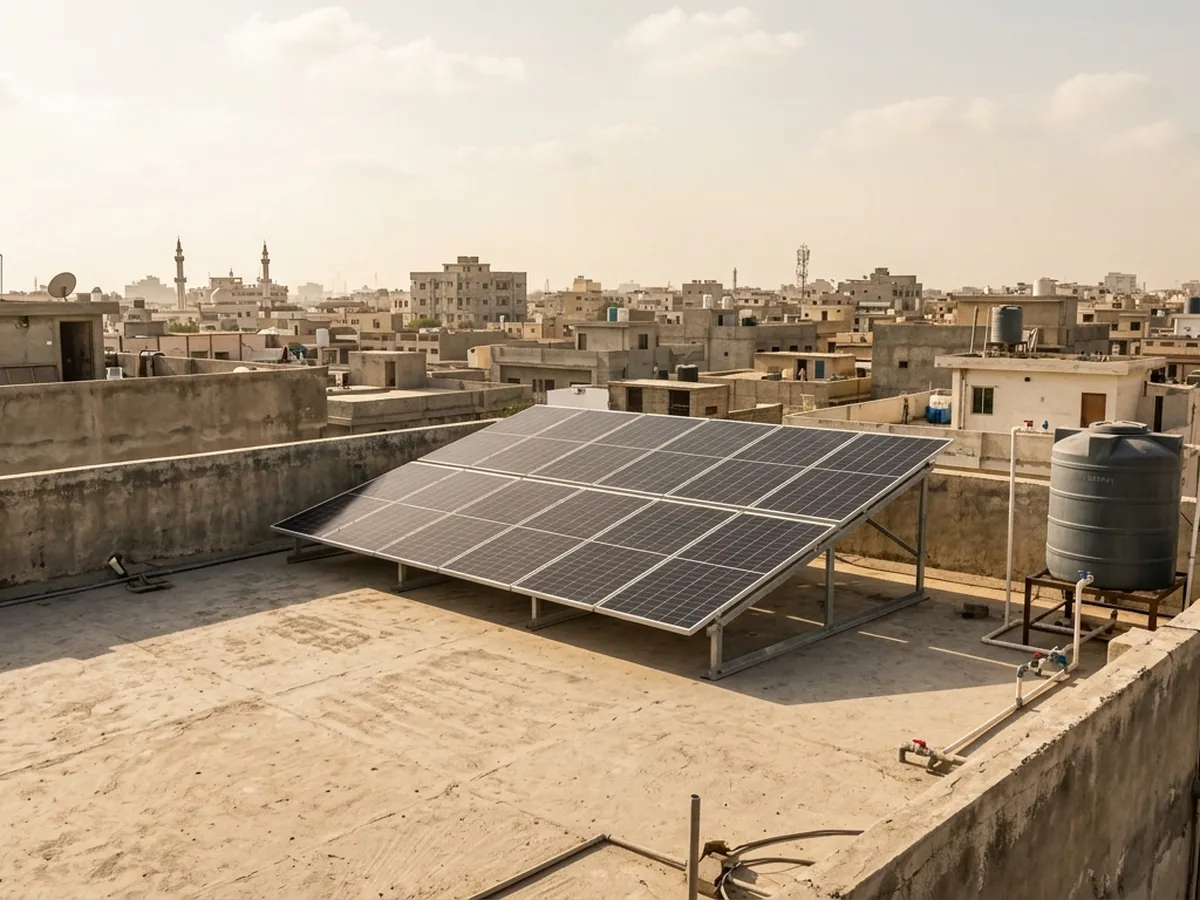
A solar sizing calculation answers four questions. How much power do you use? How many kilowatts of panels cover it? How much roof does that need? What inverter and battery go with it?
Every online calculator does the same sums. The difference is whether it shows them. Here they are in full, so you can check any result you are given, including ours.
The figures are planning figures. A site visit adjusts them for shade, tilt, dust and season.
Use your own numbers in each step.
Take the monthly units from your K-Electric bill and divide by 30.
Divide the daily units by 4 to 5, a commonly used planning figure for units per kW of panels per day. Use 4 to be careful and 5 to be optimistic.
Multiply the kW by 1,000 and divide by the panel watts. Round up. For 585 W panels, 5 kW needs 9 panels.
Multiply the panel count by about 2.6 square metres for a flat roof, to include row spacing and walking paths.
Add the running watts of the loads that run together, allow for the surge, and match the array within the inverter input limits.
Multiply the backup load in kW by the hours of cut. Divide by the usable share: about 0.9 for lithium and about 0.5 for tubular lead-acid.
A home using 600 units a month, with a 1.5 kW backup load and 4 hours of cuts.
| Step | Sum | Result |
|---|---|---|
| Daily units | 600 divided by 30 | 20 units a day |
| Panel kW | 20 divided by 4 to 5 | 4 to 5 kW |
| Panels of 585 W | 5,000 divided by 585, rounded up | 9 panels, 5.27 kW |
| Roof area | 9 times 2.6 | About 23 m² |
| Backup energy | 1.5 kW times 4 hours | 6 kWh |
| Lithium battery | 6 divided by 0.9 | About 6.7 kWh, so two 5 kWh packs |
| Tubular battery | 6 divided by 0.5 | 12 kWh on paper, so 8 batteries of 12 V 200 Ah in a 48 V bank |
The tubular bank is rounded up because a 48 V bank uses batteries in sets of four. Four batteries give 9.6 kWh on paper, which is not enough.
Copy this onto paper and fill in the blanks.
A calculator does not know about the water tank that shades your panels at 4 pm, the sanctioned load on your meter, or whether your inverter handles your air conditioner surge. Those come from a site visit. Use the answer to prepare questions, not to buy equipment.
The 3 to 6 kW system guide gives output tables for common sizes. The inverter size page and the lithium battery page go deeper on steps 5 and 6. Send us your bill and we will run the same sums with your numbers.
Short answers. For your own property, send us your electricity bill and roof details.
Ask on WhatsAppDivide your monthly units by 30, then by 4 to 5, to get the panel kilowatts. Then round up the panel count and check the roof.
A commonly used planning figure is 4 to 5 units a day. Real output depends on shading, tilt, dust and season.
Multiply the backup load in kW by the hours of cut, then divide by the usable share of the battery.
About 2.6 square metres per 585 W panel on a flat roof, including walking space.
Yes. Send your latest K-Electric bill and your appliance list on WhatsApp.
How solar works, what Karachi's climate means, and how to plan a project.
3 kW, 5 kW and 6 kW systems: output, roof area, loads and quote checks.
Inverter sizes from 1 kW to 10 kW and what each can run.
Lithium LiFePO4 batteries: capacity maths, compatibility and safe placement.
Send your bill, your appliance list and your area. We will return a size and a free itemised estimate.