Solar Systems
System sizes, what a full quote includes and how to size from your bill.
A bigger system is a different project. Three-phase supply, bigger structures and tighter paperwork all enter the plan.
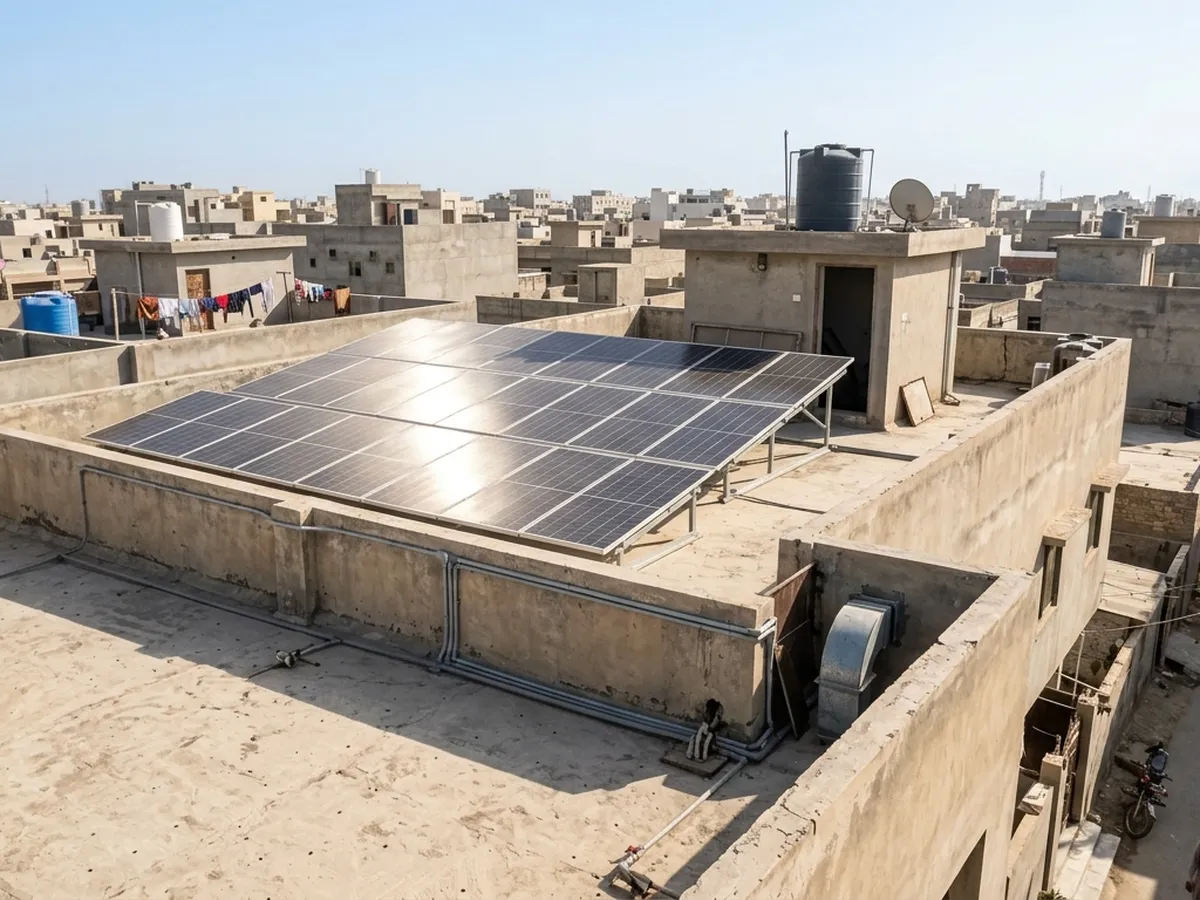
Large houses with several air conditioners, bungalows with pumps and lifts, shops with cold rooms, clinics, schools and small factories often need 8 kW or more. At that size a system serves a real business load, not just a household one.
The price table below lists the sizes we quote. The sections after it cover what changes at this scale, and what to plan from the start.
These are complete installed systems. The final price depends on roof access, cable lengths, brands and the supply.
| Item | Detail | Price (PKR) |
|---|---|---|
| 8 kW system | About 14 panels of 585 W | Rs 1,150,000 floor-mounted / Rs 1,325,000 raised |
| 10 kW on-grid | About 18 panels, no battery | Contact us for latest prices |
| 10 kW hybrid | About 18 panels, hybrid inverter and battery | Rs 1,250,000 floor-mounted / Rs 1,425,000 raised |
| 12 kW system | About 21 panels of 585 W | Rs 1,625,000 floor-mounted / Rs 1,875,000 raised |
| 15 kW system | About 26 panels of 585 W | Contact us for latest prices |
| 20 kW system | About 35 panels of 585 W | Contact us for latest prices |
Prices updated on 22 October 2026. Prices change often, so contact us for the latest exact price.
Planning figures with 585 W panels at about 2.6 square metres each, including walking space for a flat roof.
| System | Panels of 585 W | Actual array | Roof area |
|---|---|---|---|
| 8 kW | 14 | 8.19 kW | About 36 m² |
| 10 kW | 18 | 10.53 kW | About 47 m² |
| 12 kW | 21 | 12.29 kW | About 55 m² |
| 15 kW | 26 | 15.21 kW | About 68 m² |
| 20 kW | 35 | 20.48 kW | About 91 m² |
Shading, tilt row spacing and walking paths change the real area. Your survey decides the layout.
Many large buildings have a three-phase supply. A three-phase inverter, or a group of single-phase inverters balanced across the phases, must match it. Check your meter at the survey.
At this size, several smaller inverters can be better than one big one. If one fails, the others keep working, and each has its own panel inputs. A large single inverter is simpler but puts the whole system at risk if it fails.
Ask for the maximum PV input of each inverter, and for the string design, so every panel works within the voltage and current limits.
A large array puts real load on the roof. The slab or beam must carry the weight of panels and structure, and the wind force on a large area. Ask the installer to confirm the load with a structural check for large arrays.
Plan safe walkways, cable routes and clear isolation points from the start, so the array can be maintained and switched off safely.
K-Electric requires a no-objection certificate and an approved load flow study for cases above 250 kW. Systems of 8 to 20 kW are far below that line, but if a project may grow, ask early what the larger case will need.
A grid-connected system needs a K-Electric application through a PPIB pre-qualified vendor. We are not one, so we install the system and a vendor files the case. Our K-Electric guide lists the documents and time limits, and our home and commercial guide explains how usage pattern shapes the design.
Short answers. For your own property, send us your electricity bill and roof details.
Ask on WhatsAppEighteen 585 W panels give 10.53 kW. Roof area and shading decide the final layout.
About 47 square metres of clear roof with 585 W panels, including walking space. Your survey confirms it.
If your supply is three-phase, yes, usually. We check your meter at the survey.
A grid connection needs a K-Electric application through a PPIB pre-qualified vendor. Above 250 kW more papers apply.
Daytime loads suit solar well. Send us your load and bills and we will advise.
System sizes, what a full quote includes and how to size from your bill.
3 kW, 5 kW and 6 kW systems: output, roof area, loads and quote checks.
Which system fits a home, apartment, shop, office or factory.
A checklist of K-Electric documents, time limits and common rejection reasons.
Send your bills, your supply type and a roof photo. We will visit and give you a free estimate.