Solar Panels
Panel brands, wattage, price per watt and what suits Karachi conditions.
Monocrystalline and polycrystalline panels look different and perform differently. Here is the difference, and why the choice matters less than it used to.
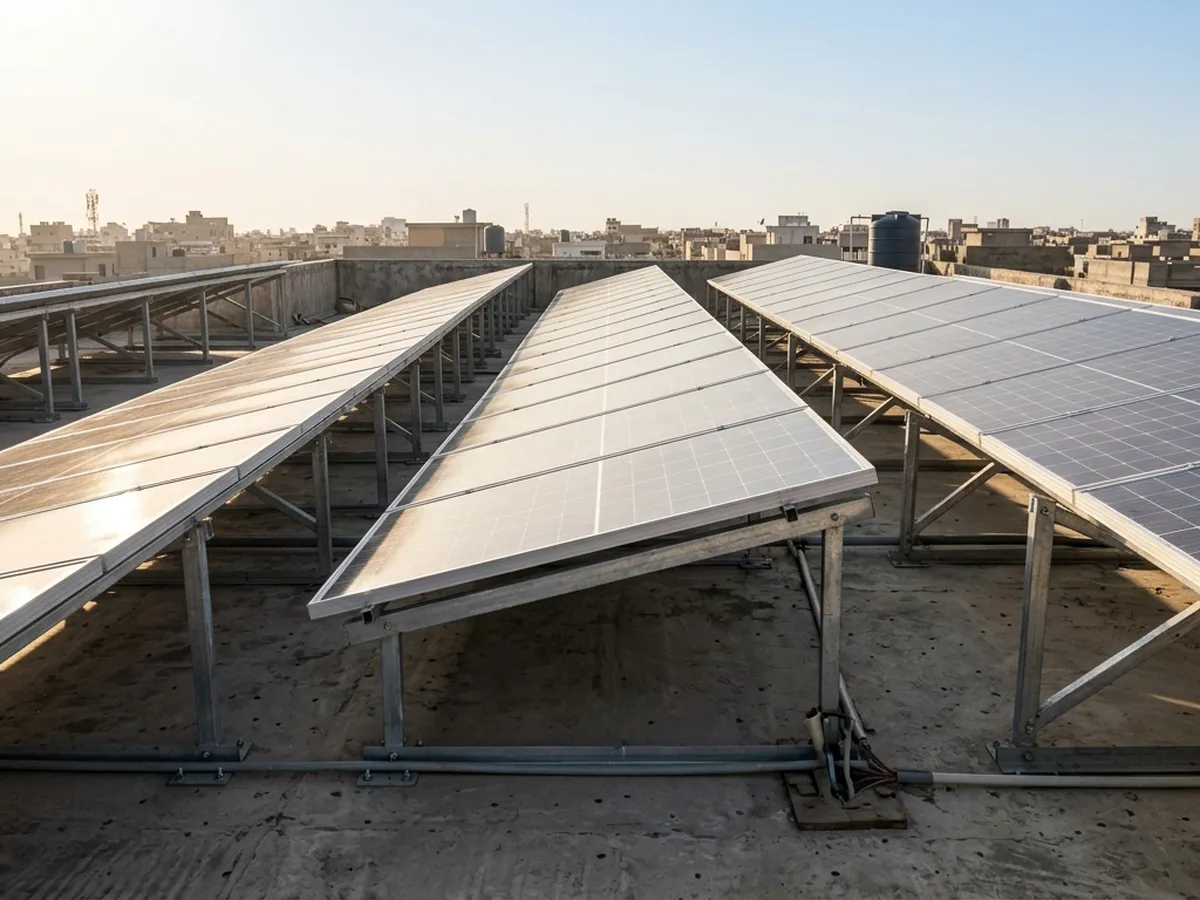
Both kinds of panel are made of silicon cells. A monocrystalline cell is cut from a single crystal of silicon. A polycrystalline cell is made from many smaller crystals melted together.
You can tell them apart by eye. Mono cells usually look uniform and dark, often with rounded corners. Poly cells look speckled and blue, with square corners.
That difference in material gives mono cells a higher efficiency. In plain terms, a mono panel makes more power from the same area.
General tendencies, not figures for a specific panel.
| Point | Monocrystalline | Polycrystalline |
|---|---|---|
| Appearance | Dark and uniform | Blue and speckled |
| Efficiency | Higher | Lower |
| Area for the same power | Smaller | Larger |
| Behaviour in heat | Usually a little better | Usually a little worse |
| Price per watt | Now similar or lower for common lines | Was lower, now uncommon |
| Availability in 2026 | Standard product | Hard to find in new large panels |
A few years ago poly panels were the budget option. Since then, mono production has grown very large and its price per watt has fallen. Most new large panels on sale in Karachi are mono, including the N-type panels sold under Jinko and other names.
That is why the question 'mono or poly' matters less than it used to. If a seller offers you a poly panel for a new system, ask why. It may be an old stock, a smaller panel or an unfamiliar line.
For most Karachi buyers the answer is mono. These points explain the exceptions.
Within mono there are further differences, such as P-type and N-type cells. N-type panels often handle heat and ageing a little better. Our Jinko page explains how to read this on a datasheet, and the best solar panels page shows how to score them.
Look at the label and the datasheet, not just the word on the box. The label states the technology on many panels, and the datasheet always does. Some sellers use the word mono for any panel, so check the cell look and the listed type.
Ask for the model name, the wattage and the warranty terms, and make sure the invoice shows tax.
Short answers. For your own property, send us your electricity bill and roof details.
Ask on WhatsAppMono panels are more efficient and handle heat a little better, and they are now the standard product. Poly panels are hard to find in new large sizes.
They used to be. Today common mono lines are often similar in price per watt, so the saving is small or gone.
It is possible but awkward. Panels of different voltages need separate strings. Ask your installer to design it.
Mono looks uniform and dark. Poly looks blue and speckled. The datasheet will state the type.
Yes. We quote mono panels from several brands, with or without installation.
Panel brands, wattage, price per watt and what suits Karachi conditions.
A situation-by-situation guide to choosing the best panel for your roof.
Jinko panel models, N-type technology and how to check what you are buying.
How to compare panel brands on cell type, warranty, availability and price per watt.
Send your roof size and your bill. We will recommend panels and give you a free estimate.